Corrosion Assessment
Corrosion assessment is a critical part of pipeline integrity management because metal loss reduces the pressure-carrying capacity of the pipe and can ultimately lead to leakage or rupture if not properly evaluated. A structured assessment converts inspection data—typically defect depth, length, width, location, and interaction with nearby features—into an estimate of remaining strength and allowable operating pressure, helping operators determine whether a feature can remain in service, requires monitoring, or needs repair.
- ASME B31G — widely used for evaluating the remaining strength of corroded pipelines based on defect depth, longitudinal extent, pipe geometry, and material strength. It is intended for metal-loss assessment in pipelines covered by transportation pipeline codes such as ASME B31.4 and B31.8.
- Modified B31G — refines the original B31G formulation to provide a less conservative and often more realistic estimate of remaining strength while retaining an established safety basis. PRCI research specifically developed the modified criterion because the original B31G method could lead to unnecessary repairs or cut-outs.
- RSTRENG / Effective Area Method — uses the measured longitudinal corrosion profile rather than representing the entire defect with a single simplified geometry. It evaluates multiple portions of the defect profile to determine the critical effective area and remaining strength. PHMSA notes that the Effective Area Method is commonly associated with the RSTRENG implementation.
- P-Squared (P²) Method — may be used as an additional remaining-strength assessment methodology where appropriate, particularly when client procedures or integrity-management practices specify its use. It provides an alternative formulation for estimating the pressure capacity of corrosion features and can be useful for comparison with B31G-based methods.
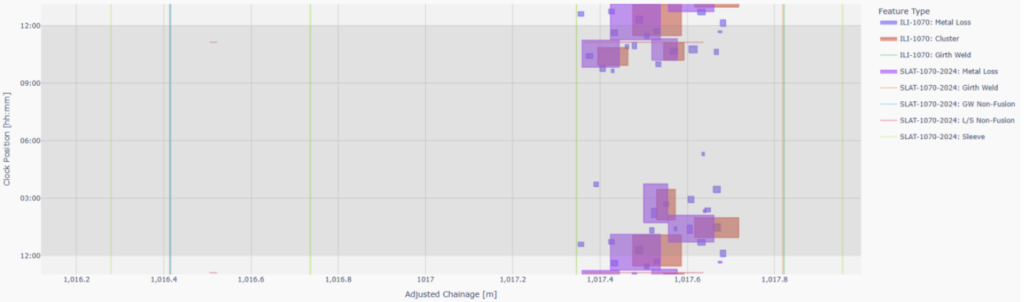
- Defect interaction assessment — closely spaced metal-loss features may interact and need to be evaluated as a combined defect rather than as isolated corrosion features.
- ILI and field-data evaluation — corrosion assessments can be performed using in-line inspection data and refined using field measurements obtained during integrity digs, improving confidence in defect geometry and remaining-strength predictions.
- Failure pressure and safe operating pressure — the calculated remaining strength can be used to establish predicted failure pressure, safety factors, and appropriate operating or repair decisions.