Geohazard Assessment
Geohazard assessment is an important component of pipeline integrity management because ground movement can impose significant axial, bending, and shear strains on a buried pipeline, often independent of internal pressure loading. Landslides, slope instability, settlement, frost heave, subsidence, seismic deformation, erosion, and other ground movements can progressively increase pipeline strain and may lead to local buckling, tensile rupture, weld failure, coating damage, or loss of containment if not properly evaluated.
- Assessment of pipelines subjected to landslides, slope movement, settlement, subsidence, frost heave, seismic deformation, erosion, and other ground-movement hazards.
- Evaluation of pipeline strain demand, bending response, axial loading, soil restraint, and interaction with surrounding ground.
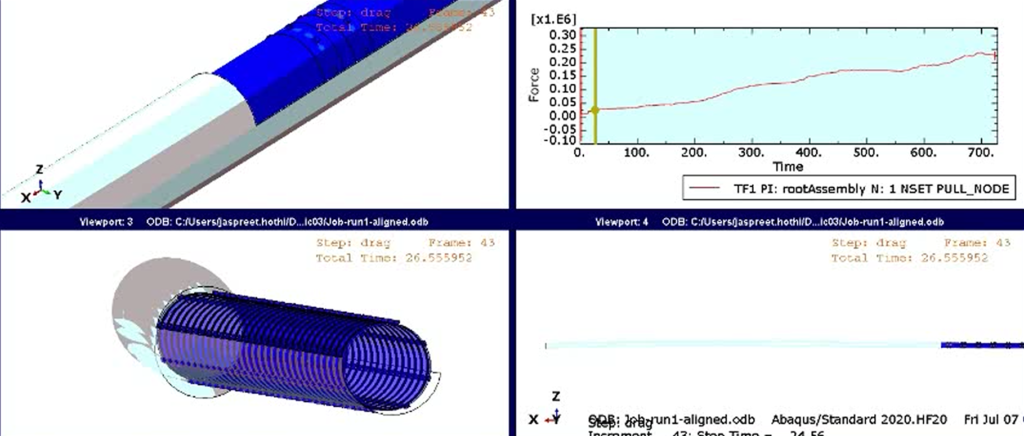
- Use of Abaqus finite element analysis to simulate nonlinear pipe-soil interaction, large deformation, material plasticity, contact, geometric imperfections, and complex ground-displacement profiles.
- Assessment of critical response parameters including tensile strain, compressive strain, local buckling susceptibility, ovalization, weld demand, and accumulated plastic deformation.
- Incorporation of survey data, geotechnical information, monitoring results, pipeline geometry, material properties, operating conditions, and construction history into the engineering assessment.
- Evaluation of potential mitigation measures such as stress relief, excavation, regrading, drainage improvements, anchoring, pipeline replacement, rerouting, or ongoing movement monitoring.
- Assessment may be performed in accordance with applicable requirements and guidance from CSA Z662, ASME B31.4, ASME B31.8, PRCI guidance, and project-specific geotechnical and integrity criteria.
- Engineering assessment supports decisions related to continued operation, monitoring frequency, allowable movement, pressure restrictions, mitigation, repair, or replacement.